What Collaboration Between Providers Actually Requires From a Cloud Platform
Building Secure, Connected, and Efficient Multicloud Infrastructure

Introduction
Cloud computing has changed from a single-provider model into a more connected environment where organizations may use multiple cloud providers, private infrastructure, and on-premises systems at the same time. This approach can provide flexibility, specialized services, and options for placing workloads where they best fit business and technical requirements.
However, simply connecting two cloud providers does not automatically create collaboration.
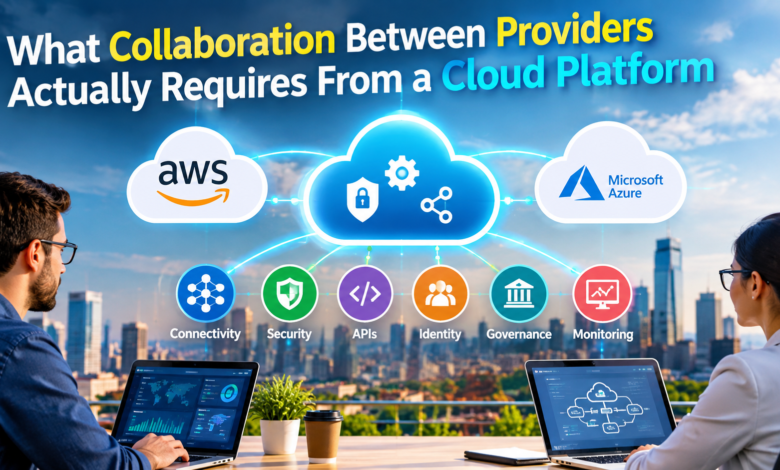
For different providers to work together effectively, the cloud platform supporting them must provide reliable connectivity, compatible interfaces, strong security, shared governance, consistent monitoring, and clear operational controls. Modern hybrid and multicloud guidance highlights these requirements because every additional environment can introduce differences in APIs, tools, service-level agreements, authentication methods, and management processes.
Understanding what genuine provider collaboration requires is therefore important for organizations building distributed applications and multi-cloud strategies.
What Does Collaboration Between Cloud Providers Mean?
Collaboration between providers means that applications, services, data, and operational systems can communicate across separate cloud environments in a controlled and dependable way.
A multicloud architecture may involve two or more public cloud service providers, while a hybrid architecture can combine public cloud resources with private infrastructure or on-premises environments.
The objective is not necessarily to make every cloud identical. Instead, the platform should provide a common foundation that allows different environments to work together despite their differences.
This requires organizations to define which workloads belong in each environment, how applications communicate, how users are authenticated, and how security and compliance policies are enforced.
Reliable Connectivity Comes First
No provider collaboration can work effectively without dependable network connectivity.
Applications distributed across cloud environments may exchange application requests, databases, files, events, or operational information. Network performance therefore directly affects application reliability.
Important considerations include:
- Bandwidth
- Latency
- Packet loss
- Network availability
- Traffic routing
- Encryption
- Regional connectivity
- Network segmentation
Cloud architecture guidance notes that connectivity decisions should consider factors such as traffic volume, cost, security, and application requirements.
A cloud platform should therefore make cross-provider networking manageable rather than treating each connection as an isolated engineering project.
APIs Create a Common Language
Cloud providers use different services and management interfaces. This can make direct integration complicated.
Application programming interfaces, or APIs, provide a structured way for systems to communicate. Instead of requiring every application to understand the internal implementation of every provider, organizations can use well-defined interfaces to expose services.
API gateways can be particularly useful when different environments use inconsistent protocols, authentication mechanisms, or backend technologies. They can provide a common layer for security, traffic management, auditing, and communication between modern and legacy systems.
For provider collaboration, a platform should therefore support:
- Standardized APIs
- API authentication
- Version management
- Rate controls
- Monitoring
- Logging
- Traffic management
- Secure API exposure
This approach reduces the amount of provider-specific logic developers need to build into applications.
Identity Must Work Across Environments
Security becomes more complicated when applications operate across multiple providers.
A user or service may begin a transaction in one cloud environment and access a resource hosted somewhere else. If identity systems cannot communicate reliably, organizations may end up creating disconnected accounts, inconsistent permissions, and complicated access procedures.
A collaborative cloud platform should support consistent authentication and authorization across environments.
Organizations also need clear controls for:
- Human users
- Service accounts
- Workload identities
- Privileged administrators
- API clients
- Automated systems
Google Cloud’s multicloud guidance specifically identifies consistent authentication, authorization, auditing, and policies as important operational considerations.
The goal is not simply to make access possible. Access should remain controlled and traceable regardless of where the workload operates.
Security Cannot Stop at the Cloud Boundary
Traditional security models often focus heavily on individual environments. In a multi-provider architecture, however, the communication between environments becomes another important security boundary.
Data moving between providers should be protected in transit. Network segmentation, encryption, access controls, API security, and centralized visibility can help reduce unnecessary exposure.
A platform may also use gateways or service-mesh technologies to control communication between services. Such systems can help manage authentication, authorization, encryption, and service-to-service communication.
Security policies should be designed across the complete architecture rather than independently for every provider.
Shared Governance Creates Consistency
Different cloud providers have different tools and policies. Without centralized governance, teams may configure similar resources in completely different ways.
This can create problems with security, compliance, cost management, and operational consistency.
A collaborative cloud platform should help organizations establish common policies covering areas such as:
- Resource access
- Data protection
- Compliance
- Network security
- Configuration standards
- Logging
- Backup requirements
- Cost controls
- Deployment practices
Governance does not necessarily mean forcing every workload into exactly the same configuration. Instead, it establishes common organizational rules while allowing technical differences where they are justified.
Monitoring Should Provide a Unified View
One of the biggest operational challenges in multi-cloud environments is visibility.
Each provider may have its own dashboards, logs, metrics, alerts, and monitoring tools. Engineers who must constantly switch between separate systems can find it difficult to understand what is happening across the entire application.
A unified monitoring approach can provide visibility into:
- Application performance
- Infrastructure health
- Network activity
- Security events
- Service availability
- Errors
- Resource consumption
- Operational trends
Hybrid and multicloud monitoring architectures commonly use centralized or coordinated approaches to give operations teams broader visibility across environments.
This becomes especially important when an application is distributed across multiple providers and a failure in one environment affects services elsewhere.
Data Movement Requires Careful Planning
Provider collaboration often depends on moving data between environments.
But data movement is not simply a networking problem. Organizations must consider data volume, latency, encryption, cost, regulatory requirements, data residency, and application dependencies.
Some workloads may require frequent low-latency communication, while others can transfer information periodically.
A cloud platform should therefore help teams determine:
- Where data should reside
- Which systems can access it
- How it is transferred
- How it is encrypted
- How long it is retained
- What happens if a connection fails
Cloud architecture guidance emphasizes that application dependencies, latency, licensing, and regulatory constraints can influence where workloads and data should operate.
Consistent DevOps Practices Matter
Provider collaboration also affects software development.
If developers use completely different deployment processes for every cloud environment, application delivery becomes slower and more complicated.
Common CI/CD pipelines, infrastructure-as-code practices, configuration management, testing procedures, and release controls can reduce unnecessary differences.
Consistent tooling does not mean every provider must use identical services. Instead, organizations can establish common processes for building, testing, securing, deploying, and monitoring applications.
This makes it easier for teams to understand how applications behave across environments.
Portability Has Limits
Cloud platforms are often discussed in terms of portability, but complete portability is difficult.
Every provider offers different services, APIs, performance characteristics, pricing models, regions, and operational features. Trying to eliminate every difference can sometimes make an architecture unnecessarily complicated.
A practical approach is to decide where portability actually matters.
For example, organizations may keep application interfaces relatively portable while deliberately using provider-specific services where they offer meaningful technical benefits.
The important question is not whether everything can move instantly between providers. The more useful question is whether the architecture provides an acceptable level of flexibility for the organization’s business requirements.
A Collaborative Cloud Platform Needs Operational Discipline
Technology alone cannot create effective provider collaboration.
Organizations also need clearly defined ownership and operating procedures.
Teams should understand:
- Who owns each workload
- Who manages network connections
- Who approves access
- Who responds to incidents
- Who manages compliance
- Who controls deployment changes
- Who monitors performance
- Who communicates with external providers
Without these responsibilities, even technically sound infrastructure can become difficult to operate.
Conclusion
What collaboration between providers actually requires from a cloud platform is much more than a connection between two networks.
A capable platform needs reliable connectivity, standardized APIs, cross-environment identity, security controls, unified governance, centralized visibility, carefully planned data movement, and consistent development and operational practices.
Hybrid and multicloud architectures can support different business and technical objectives, but they also introduce additional complexity. Current architecture guidance recommends defining business objectives and technical requirements first, then selecting appropriate architecture and connectivity patterns around those needs.
The most sustainable approach is therefore not to pretend that different cloud providers are identical. It is to build a platform layer that manages their differences while giving applications and teams consistent ways to communicate, secure resources, monitor systems, and operate services.
That foundation is what turns multiple cloud environments from separate infrastructures into a coordinated technology ecosystem.